Global Digital Transformation & Customer Experience Moderniz

Modernizing commerce, operations, and customer engagement
A global, multi-brand organization needed to modernize customer channels, digital commerce, internal operations, and employee collaboration. The initiative created a more connected customer experience while improving the systems, processes, and operating capabilities supporting global growth.
Challenge
A global, multi-brand organization needed to move beyond disconnected systems, manual processes, paper-based workflows, and traditional customer interactions. The business required a coordinated digital strategy, as highlighted in various Cyber Virtues case studies, that improved online sales, enabled remote work, modernized technology operations leadership, and fostered more direct digital relationships with customers.
Action
Led a global digital transformation that encompassed customer experience, eCommerce, internal operations, collaboration, and organizational adoption, as highlighted in various Cyber Virtues case studies.
The program included:
- Consolidating global brands and markets onto modern digital-commerce platforms,
- Expanding digital sales and customer self-service,
- Supporting customer mobile applications and digital engagement,
- Enabling targeted social-media and customer-communication capabilities,
- Moving operational processes into secure digital workflows,
- Transitioning teams to remote and hybrid work,
- Replacing paper-based processes with standardized digital procedures,
- Establishing governance, accountability, KPIs, and adoption plans,
- And helping employees transition toward a more digital-first culture through effective executive technology solutions and strong technology operations leadership.
Results
The transformation established a more scalable and connected digital operating model, reflecting insights from Cyber Virtues case studies. Customers gained improved access to products, services, and self-service options, while employees benefited from more consistent tools, workflows, and information aligned with executive technology solutions. This shift enabled the organization to enhance technology operations leadership, positioning it better to increase digital sales, improve customer engagement, reduce manual work, support remote operations, and make faster data-informed decisions.
Related Services
Digital transformation and customer experience are essential components of any eCommerce strategy, including process digitization and remote-work enablement. These aspects are crucial for effective change management and are supported by data and analytics. Successful program leadership, such as that seen in Cyber Virtues case studies, exemplifies the need for executive technology solutions and technology operations leadership.
60-Day Enterprise Technology Risk & Discovery Assessment
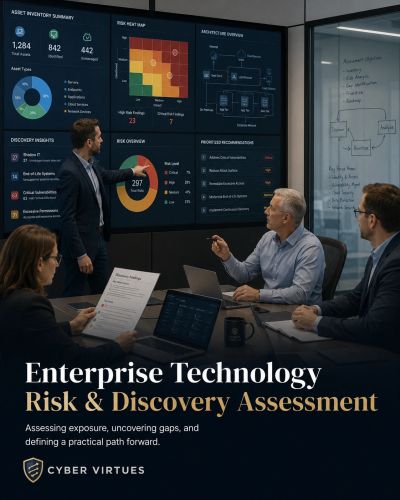
Creating clarity around risk, priorities, investment, and execution
Challenge
A complex organization needed an independent assessment of its technology environment, cybersecurity posture, applications, vendors, operating model, and delivery capability. Leadership lacked a clear enterprise view of the most significant risks, where investments should be prioritized, and whether current technology initiatives were aligned with business needs. Legacy systems, duplicated tools, unclear ownership, inconsistent controls, and competing priorities had increased operational complexity.
Action
- Led a structured 60-day assessment covering:
- Technology strategy, governance, budgets, and project priorities
- Infrastructure, cloud, networks, endpoints, backup, and disaster recovery
- Cybersecurity controls, identity, vulnerability management, and incident response
- Enterprise applications, integrations, digital platforms, and technical debt
- Data, reporting, analytics, and ownership
- Service management, support performance, and change control
- Vendor contracts, licensing, costs, dependencies, and accountability
- Team structure, leadership capacity, staffing, skills, and key-person risk
The engagement included executive interviews, technical reviews, document analysis, stakeholder workshops, and validation of findings with business and technology leaders.Recommendations were organized into immediate risk-reduction actions, 30- to 90-day stabilization priorities, and longer-term modernization initiatives. Each recommendation identified the business impact, risk addressed, ownership, dependencies, and expected level of effort.
Result
Leadership received a clear current-state assessment, prioritized risk register, and practical roadmap for stabilization, modernization, and transformation.
The engagement:
- Identified material technology, cybersecurity, and continuity risks
- Clarified ownership, governance, and accountability gaps
- Prioritized investments based on urgency, risk, and business value
- Improved visibility into technical debt, vendor performance, staffing needs, and project risk
- Established a shared direction for business and technology leadership
- Enabled high-priority initiatives to move forward with greater confidence
The result was more than a technical review. It provided leadership with an executive decision-making framework and a realistic path forward.
Related Services
Technology assessments, risk registers, and IT strategy are essential components of our Cyber Virtues case studies. We focus on effective budget planning and vendor management while ensuring robust technology operations leadership. Additionally, our infrastructure review and cybersecurity strategies are aligned with comprehensive transformation roadmaps.
Operational Excellence & Organizational Transformation

Building accountable teams, repeatable processes, and measurable performance
Challenge
A global, multi-brand organization was operating through a fragmented model shaped by regional practices, functional silos, inconsistent processes, unclear ownership, and limited enterprise-wide visibility. Critical activities often depended on manual work, spreadsheets, email-based approvals, local workarounds, and individual knowledge. Business units used different methods to plan work, manage vendors, resolve issues, measure performance, and prioritize investments. This created duplicated effort, slower decision-making, uneven service delivery, and difficulty holding teams accountable for outcomes.
Leadership needed more than a technology modernization effort. The organization required an operational transformation that would:
- Clarify decision rights, ownership, and accountability
- Standardize critical business and support processes
- Improve coordination across regions and functions
- Strengthen performance management and executive visibility
- Reduce operational friction, duplication, and manual work
- Improve vendor, financial, and resource discipline
- Build a scalable operating model capable of supporting growth and change
- Create a culture focused on execution, service, and measurable results
Action
Led a COO-level operational excellence program focused on improving how the organization planned, governed, executed, and measured work across global functions. The transformation combined operating-model design, process improvement, organizational alignment, performance management, technology enablement, and leadership development.
The program included:
- Assessing the current operating model across people, processes, technology, governance, vendors, and organizational structure
- Mapping end-to-end workflows to identify bottlenecks, duplicated effort, control gaps, handoff failures, and unnecessary complexity
- Redesigning critical processes around clear ownership, standard procedures, service expectations, and measurable outcomes
- Establishing decision rights, accountability structures, escalation paths, and cross-functional governance
- Defining roles and responsibilities through operating charters, responsibility matrices, and service ownership
- Creating standardized planning, prioritization, budgeting, and resource-allocation processes
- Establishing executive operating cadences, steering committees, performance reviews, and issue-resolution forums
- Developing enterprise KPIs, operational dashboards, service measures, and management reporting
- Strengthening project and program governance to improve delivery discipline, dependency management, and executive visibility
- Improving vendor oversight through clearer performance expectations, contract accountability, cost controls, and service reviews
- Evaluating organizational capacity, leadership gaps, spans of control, team structure, and required capabilities
- Building stronger leadership bench strength and increasing accountability at each management level
- Moving manual and paper-based activities into standardized digital workflows
- Using automation and technology to reduce repetitive work, improve data quality, and accelerate turnaround times
- Aligning operational priorities with strategic goals, financial expectations, customer needs, and risk tolerance
- Leading change-management, communication, training, and adoption efforts to embed new ways of working
Result
The transformation established a more disciplined, transparent, and scalable global operating model.
Leadership gained clearer visibility into performance, priorities, risks, costs, and execution. Teams gained better-defined responsibilities, more consistent processes, improved decision-making structures, and stronger alignment across functions and regions.
The program also:
- Reduced operational fragmentation and dependence on local workarounds
- Improved accountability through clearly assigned owners and measurable expectations
- Standardized critical workflows and management practices
- Strengthened executive governance and decision-making
- Improved coordination across technology, operations, finance, commercial teams, and regional leadership
- Increased visibility into project status, service performance, vendor results, and operational risk
- Reduced manual effort and administrative friction through process redesign and automation
- Improved resource prioritization and investment discipline
- Strengthened organizational capability, leadership effectiveness, and execution consistency
- Created a foundation for continued growth, integration, cost optimization, and enterprise transformation
The result was not simply a process-improvement initiative. It was a broader organizational transformation that strengthened how the company operated, made decisions, managed performance, and delivered results across the enterprise.
Related Services
Cyber Virtues helps organizations strengthen operational performance through operating-model design, process improvement, governance, organizational alignment, performance management, and technology-enabled automation. Services include executive and fractional leadership, workflow redesign, KPI development, vendor oversight, program recovery, change management, and enterprise transformation—helping leadership teams improve accountability, reduce operational friction, and create a more scalable, disciplined organization.
Global M&A Technology Due Diligence & Integration
Reducing acquisition risk and supporting a smooth post-close transition
Challenge
A global company was preparing for and executing a major merger involving multiple brands, business units, countries, technology environments, and operating models. The transaction created significant complexity across infrastructure, enterprise applications, cybersecurity, data, digital commerce, vendors, contracts, support models, and organizational responsibilities.
Technology risks and integration requirements needed to be understood before the acquisition, actively managed during the transaction, and addressed after closing. Leadership also needed a clear view of the investment required, the operational risks involved, and the sequence of initiatives necessary to combine the organizations without disrupting customers, employees, or critical business operations.
The organization required a structured M&A technology program that could:
- Identify material risks and integration dependencies before closing
- Validate assumptions throughout the acquisition process
- Define the future-state technology operating model
- Prioritize investments based on risk, value, timing, and business impact
- Present clear recommendations to executive leadership, boards, and key stakeholders
- Convert approved recommendations into executable projects
- Track progress, decisions, risks, and benefits through post-acquisition integration
Action
Led technology due diligence and integration planning across the full transaction lifecycle: pre-acquisition, during the acquisition, and post-close execution. The work brought together executive leadership, business stakeholders, legal, finance, operations, cybersecurity, technology teams, regional leaders, and external partners to create a coordinated view of the combined environment.
Pre-Acquisition Due Diligence
The initial phase focused on identifying risks, costs, constraints, and integration opportunities before the transaction was finalized.
Activities included:
- Assessing infrastructure, cloud platforms, networks, data centers, endpoints, and telecommunications
- Reviewing enterprise applications, ERP platforms, customer systems, digital commerce, collaboration tools, and regional systems
- Evaluating cybersecurity controls, vulnerabilities, identity management, regulatory exposure, data protection, and incident-readiness capabilities
- Reviewing vendor contracts, licensing obligations, renewal timelines, service dependencies, and change-of-control provisions
- Identifying unsupported systems, technical debt, single points of failure, and operational resilience concerns
- Evaluating technology teams, organizational capabilities, support models, and key-person dependencies
- Estimating integration costs, transition requirements, separation needs, and potential synergies
- Documenting risks, assumptions, dependencies, and recommended actions for executive review
- Transaction and Integration Planning
During the acquisition, the findings were converted into a prioritized integration strategy and multi-phase roadmap.
The program included:
- Defining Day One, first 30-day, 90-day, and longer-term integration priorities
- Establishing the future-state technology architecture and operating model
- Identifying systems to retain, consolidate, replace, migrate, or retire
- Prioritizing cybersecurity, identity, infrastructure, data, application, and operational initiatives
- Defining workstreams, owners, timelines, dependencies, costs, and expected outcomes
- Creating governance, decision-making, escalation, and reporting structures
- Aligning regional and business requirements with the global integration plan
- Developing budget recommendations and investment cases for major initiatives
- Presenting risks, roadmaps, project priorities, and funding requirements to boards, executive leadership, and key stakeholders
Post-Acquisition Execution
Following approval, the roadmap was translated into a governed portfolio of integration projects.
Execution included:
- Launching approved infrastructure, application, security, data, and collaboration initiatives
- Coordinating project sequencing to reduce operational disruption and integration risk
- Tracking milestones, budgets, risks, dependencies, and business readiness
- Managing internal teams, vendors, implementation partners, and regional stakeholders
- Providing regular progress reporting to executives, boards, and steering committees
- Adjusting the roadmap as new information, business priorities, or risks emerged
- Confirming that projects were executed according to the approved integration plan
- Establishing ownership and operating processes for the combined organization
Result
The organization gained a structured, fact-based technology integration strategy that supported the merger from initial due diligence through post-acquisition execution. Leadership received clear visibility into technology risks, investment requirements, integration priorities, and expected business outcomes. Boards and stakeholders were able to review and approve a sequenced roadmap rather than make isolated technology decisions without full context.
The program also:
- Identified material technology and cybersecurity risks before and during the transaction
- Established a clear future-state direction for the combined organization
- Created prioritized roadmaps covering immediate, near-term, and long-term initiatives
- Improved alignment among technology, operations, finance, legal, and executive leadership
- Secured approval for critical integration projects and required investments
- Enabled approved projects to be executed in a controlled, coordinated manner
- Reduced duplication across systems, vendors, platforms, and operating processes
- Strengthened governance, accountability, and executive visibility throughout the integration
- Created a more scalable and supportable global technology operating model
The result was a disciplined M&A technology integration program that moved beyond due-diligence findings and converted them into approved roadmaps, funded initiatives, and successfully executed transformation projects.
Related Services
Pre-acquisition technology due diligence, post-close integration planning, Day One readiness, cybersecurity and operational risk assessment, application and infrastructure rationalization, vendor and contract review, integration-roadmap development, board reporting, and program execution.
Global Shopify eCommerce & Digital Commerce Consolidation
Unifying brands, markets, systems, and customer channels
Challenge
A global, multi-brand organization operated separate eCommerce environments across brands, markets, and regions. The fragmented model increased complexity, created inconsistent customer experiences, and made platform support, integration, governance, and future expansion more difficult.
Action
Led the consolidation and modernization of the organization’s global digital-commerce environment.
The program included:
- Consolidating multiple brands and markets onto Shopify
- Establishing common platform, governance, and support standards
- Evaluating and selecting Shopify applications based on business requirements, integration compatibility, scalability, security, and total cost of ownership
- Integrating Shopify with ERP, fulfillment, payment, tax, marketing, customer-service, and support platforms
- Coordinating internal teams, implementation partners, vendors, and regional stakeholders
- Establishing launch plans, testing processes, production-support procedures, and operating ownership
- Supporting employee adoption and the transition to a more consistent global eCommerce operating model
Result
The program created a more scalable and supportable digital-commerce platform across brands and markets. It improved platform consistency, simplified integrations and vendor management, strengthened governance, and created a foundation for continued digital growth and customer-experience improvement.
Related Services
Global Shopify strategy, website consolidation, application selection, ERP integration, eCommerce operating-model design, production support, platform governance, vendor management, launch planning, and digital customer-experience optimization.
3,000-User Collaboration, Identity & Device Management Migra
Modernizing enterprise collaboration while minimizing disruption
Challenge
A global, multi-brand organization operating across several countries relied on Google Workspace and a combination of disconnected collaboration, communication, file-sharing, identity, and device-management tools. The organization needed to migrate approximately 3,000 users to a unified Microsoft 365 environment while strengthening governance, security, collaboration, and remote-work capabilities.
Result
The migration created a more secure, connected, and standardized digital workplace for approximately 3,000 users. Employees gained a consistent suite of tools for email, meetings, document sharing, communication, and collaboration. Leadership gained stronger governance, improved visibility, and a more scalable platform for supporting global operations.
Related Services
Cyber Virtues provides end-to-end leadership for Microsoft 365 migrations and digital workplace transformation. Services span strategy, architecture, identity, collaboration, device management, governance, migration execution, communications, training, and adoption—helping organizations move to a secure, standardized, and scalable modern workplace.